Business Email Compromise
Business Email Compromise
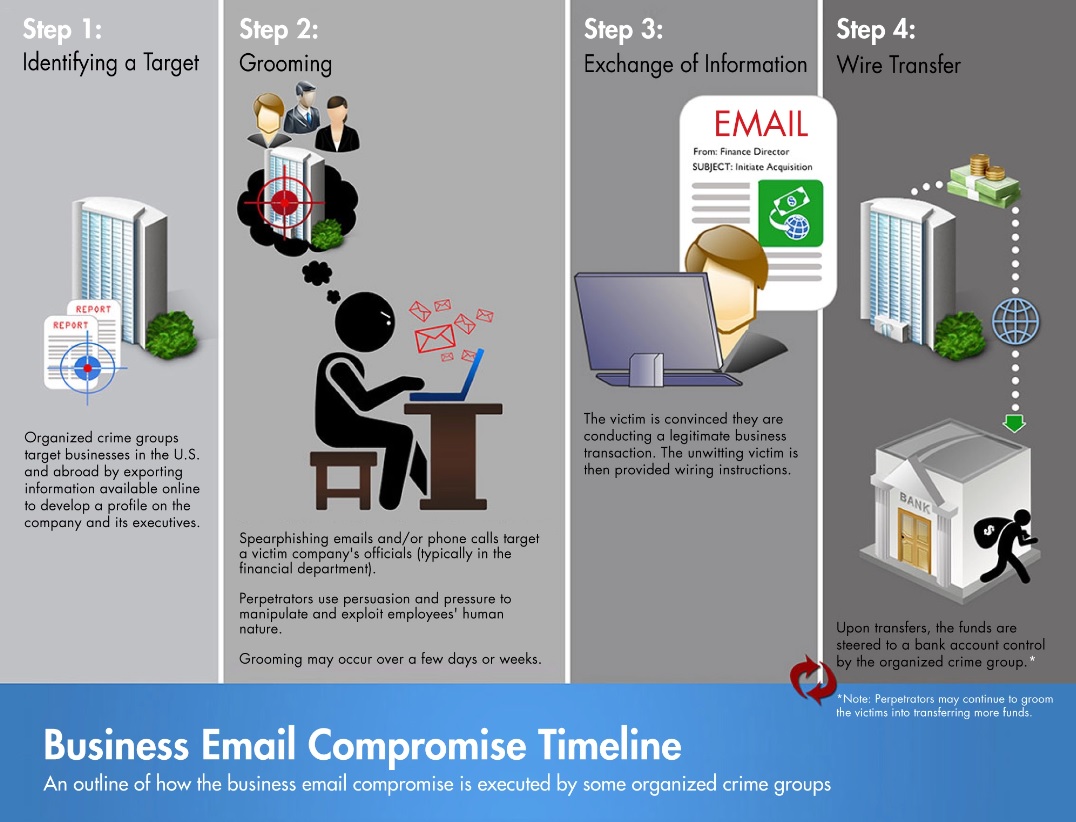
Business email compromise (BEC)—also known as email account compromise (EAC)—is one of the most financially damaging online crimes.
In a BEC scam, criminals send an email message that appears to come from a known source making a legitimate request, like in these examples:
- A vendor your company regularly deals with sends an invoice with an updated mailing address.
- A company CEO asks her assistant to purchase dozens of gift cards to send out as employee rewards. She asks for the serial numbers so she can email them out right away.
- A home buyer receives a message from his title company with instructions on how to wire his down payment.
How Criminals Carry Out BEC Scams
- Spoof an email account or website. Slight variations on legitimate addresses (john.kelly@examplecompany.com vs. john.kelley@examplecompany.com) fool victims into thinking fake accounts are authentic.
- Send spear-phishing emails. These messages look like they’re from a trusted sender to trick victims into revealing confidential information. That information lets criminals access company accounts, calendars, and data that gives them the details they need to carry out the BEC schemes.
- Use malware. Malicious software can infiltrate company networks and gain access to legitimate email threads about billing and invoices. That information is used to time requests or send messages so accountants or financial officers don’t question payment requests. Malware also lets criminals gain undetected access to a victim’s data, including passwords and financial account information.
How to Protect Yourself
- Don’t click on anything in an unsolicited email or text message asking you to update or verify account information. Look up the company’s phone number on your own (don’t use the one a potential scammer is providing), and call the company to ask if the request is legitimate.
- Be careful with what information you share online or on social media. By openly sharing things like pet names, schools you attended, links to family members, and your birthday, you can give a scammer all the information they need to guess your password or answer your security questions.
- Carefully examine the email address, URL, and spelling used in any correspondence. Scammers use slight differences to trick your eye and gain your trust.
- Be careful what you download. Never open an email attachment from someone you don't know, and be wary of email attachments forwarded to you.
- Set up two-factor (or multi-factor) authentication on any account that allows it, and never disable it.
- Verify payment and purchase requests in person if possible or by calling the person to make sure it is legitimate. You should verify any change in account number or payment procedures with the person making the request.
- Be especially wary if the requestor is pressing you to act quickly.
- Call a known number and verify the information.